
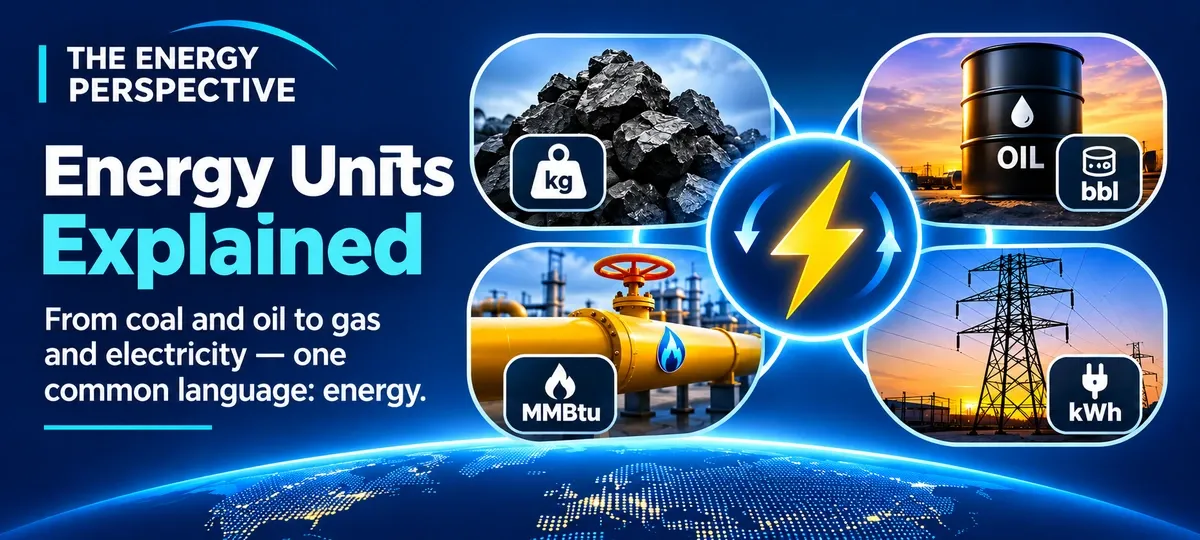
Understanding Energy
From a kilogram of coal to a kilowatt-hour of electricity.
An introduction to the units that measure the energy powering our world.
Imagine a teenager standing in a kitchen, watching water boil in an electric kettle.
The kettle consumes electricity.
That electricity may have come from a wind turbine, a solar panel, a nuclear reactor or a power station burning natural gas or coal.
Now imagine a car driving past the house. It runs on petrol refined from crude oil, which is traded internationally in barrels.
The house may also use natural gas for heating. Gas is measured in cubic metres, cubic feet or units of heat called BTUs.
Three everyday activities, three different fuels, and several different measurement units.
Yet they all have something in common.
They involve energy, the capacity to produce heat, motion, light or other physical changes.
To understand the modern energy system, we must learn how to translate these different measurements into a common language.
1. First, understand the difference between energy and power
Consider two people carrying water upstairs.
One carries ten buckets in ten minutes. Another carries the same ten buckets in five minutes.
Both perform approximately the same amount of work, but the second person does it twice as quickly.
That is the difference between energy and power.
- Energy tells us how much work can be done.
- Power tells us how quickly energy is transferred or used.
The international unit of energy is the joule (J), named after physicist James Prescott Joule.
One joule is a small amount of energy. Lifting an ordinary apple by roughly one metre requires about one joule of work.
A watt is a measure of power:
1watt=1joulepersecond
A 1,000-watt kettle uses energy at a rate of 1,000 joules every second.
If it operates for one hour, it consumes:
1,000W1hour=1kWh
And:
1kWh = 3.6 million joules
This is our first important connection. A joule and a kilowatt-hour measure the same physical quantity, energy, but on different scales.
2. Coal: energy measured by weight
Coal is a solid fuel. It is generally bought and transported by weight, usually kilograms or tonnes.
A kilogram of thermal coal contains approximately 24 megajoules (MJ) of chemical energy, although actual values vary considerably with coal quality and moisture.
Since 1 kWh equals 3.6 MJ, hence, 24 / 3.6 6.7 kWh
That means one kilogram of this coal contains approximately 6.7 kWh of thermal energy.
But there is a catch.
A coal-fired power station cannot convert all that heat into electricity. If its efficiency is 35%, the electricity produced is approximately:
6.7 x 35% 2.3 kWh
The rest of the energy is mainly released as waste heat.
Lesson: The energy contained in a fuel is not necessarily the useful energy we obtain from it.
3. Oil: why the world measures it in barrels
Unlike coal, crude oil is a liquid. The oil industry commonly measures it by volume.
One standard petroleum barrel contains 42 US gallons, approximately 159 litres.
A typical barrel of crude oil contains roughly 6.1 gigajoules (GJ) of energy, although the value depends on its composition.
That is: 6,100 MJ 3.6 1,694kWh
So one barrel of crude oil contains approximately 1,700 kWh of chemical energy.
This does not mean we can simply connect a barrel of crude oil to a house and obtain 1,700 kWh of electricity. Oil must first be processed or burned in suitable equipment, and every conversion involves losses.
A barrel is therefore a measure of volume, not energy. We estimate the energy content from the properties of the crude oil.
4. Natural gas: from cubic feet to MMBtu
Natural gas creates an interesting measurement problem.
It is a gas, so its volume changes with temperature and pressure. That is why gas volumes are reported at defined reference conditions.
Gas can be measured in cubic metres (m³), cubic feet (scf) or millions of standard cubic feet (MMscf).
But the volume of gas alone does not tell us exactly how much energy it contains. Gas composition also matters.
The industry therefore frequently uses a heat unit called the British thermal unit (Btu).
One Btu equals approximately 1,055 joules.
One million Btu is written as MMBtu.
Understanding the abbreviations
| Unit | Meaning |
|---|---|
| scf | Standard cubic foot of gas |
| MMscf | One million standard cubic feet |
| MMBtu | One million British thermal units |
| 1 MMBtu | Approximately 293 kWh of thermal energy |
Approxx. 1,000 standard cubic feet of typical natural gas contains approximately 1 MMBtu of energy.
Therefore:
1MMscf 1,000 MMBtu
The precise conversion varies with gas composition and the standard conditions used.
This explains why gas markets use different pricing conventions. American natural gas is commonly priced in dollars per MMBtu, while European TTF gas is commonly quoted in euros per MWh.
Both are ultimately prices for energy.
5. Electricity: why the bill uses kilowatt-hours
Electricity is different from coal, oil and gas. It is not a fuel extracted from the ground.
It is a form of energy that can be produced from many primary energy sources and delivered through electrical networks.
Your electricity bill normally measures the energy consumed in kilowatt-hours (kWh).
For example, a 100-watt light bulb operating for ten hours consumes:
100W10h=1,000Wh=1kWh
A 2,000-watt heater operating for one hour consumes 2 kWh.
The heater uses energy twice as quickly as a 1,000-watt device, but if the latter runs for two hours, both consume the same 2 kWh.
This is why the distinction between power and energy is essential.
6. Bringing all the units together
Here is the most useful way to connect everything: express the energy contained in different fuels in kilowatt-hours.
Approximate thermal energy content, not electricity output.
| Energy source or unit | Equivalent energy |
|---|---|
| 1 kg typical thermal coal | ~6.7 kWh |
| 1 litre crude oil | ~10.7 kWh |
| 1 barrel crude oil | ~1,700 kWh |
| 1 MMBtu natural gas | ~293 kWh |
| 1 MMscf natural gas | ~293,000 kWh |
| 1 kWh electricity | 1 kWh |
| 1 joule | 0.000000278 kWh |
7. The energy journey: from underground to your home
Simplified pathway for fossil-fuel electricity generation. Oil and gas can also be used directly for transport, heating and industrial processes.
The key idea is that the units used at each stage reflect what is easiest to measure.
- Coal is weighed.
- Oil is measured by volume.
- Natural gas is measured by volume or energy content.
- Electricity is measured by energy delivered.
But all of them can ultimately be expressed in joules.
8. A final lesson: energy is conserved, but useful energy is not
Suppose we have 100 units of chemical energy in a fuel.
A power station converts 40 units into electricity and releases 60 units as waste heat.
The energy has not vanished. It has changed form.
This is an expression of the first law of thermodynamics: energy cannot be created or destroyed, only transformed or transferred.
But not all forms of energy are equally useful.
Electricity can operate a motor, illuminate a room or run a computer with great precision. Low-temperature waste heat is often much harder to use productively.
That brings us to the second law of thermodynamics, which helps explain why energy conversions are never perfectly efficient and why the quality of energy matters.
The energy transition is therefore not simply a story of replacing one fuel with another. It is also a story of converting, transporting and using energy more efficiently.
The five numbers worth remembering
| Key figure | What it represents |
|---|---|
| 3.6 MJ | Energy in 1 kWh |
| 24 MJ | Energy in 1 kg of thermal coal |
| 159 litres | Volume in 1 barrel of crude oil |
| 293 kWh | Energy in 1 MMBtu |
| 1,700 kWh | Energy in 1 barrel of crude oil |
Closing perspective
A barrel of oil, a kilogram of coal, a cubic foot of gas and a kilowatt-hour of electricity may look like unrelated measurements.
Different measurement units are ways of describing the same physical reality: energy.
- The units tell us how we measure it.
- Thermodynamics tells us what happens when we convert it.
- Economics tells us what it costs.
- Technology determines how efficiently we can put it to work.
To understand the world's energy system, start not with the price of a barrel or the capacity of a power station, but with the simple question: how much energy is available, and how much of it can we actually use?
That is the foundation for understanding energy markets, power generation, climate change and the economics of the energy transition.
All fuel conversions are approximate and depend on composition, heating-value conventions and operating conditions.